
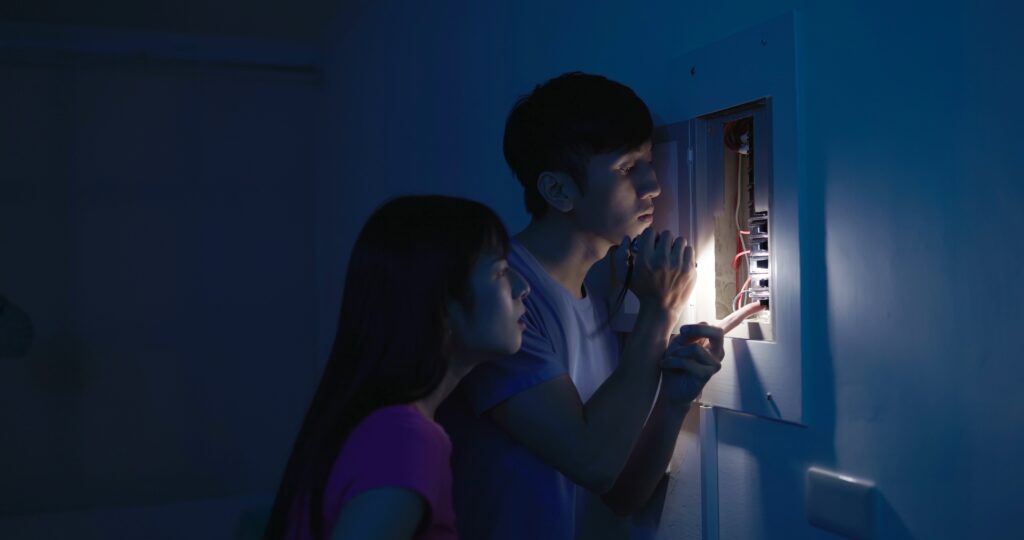
There are few things more frustrating than losing power in the middle of your day. You’re washing dishes or folding laundry, vacuuming or cooking dinner, and suddenly: click. Everything grinds to a halt as the lights go out, your appliances turn off, and you’re left wondering what just happened. Electrical problems that cause your home to lose power repeatedly are annoying — but they can also indicate your system may not be safe.
Needing to understand why your circuit breaker keeps tripping is only natural. You want your electricity to work reliably, so you can get on with life without worrying whether it’s going to continue or fall apart. While it may be frustrating, your breaker tripping is your electrical system doing its job to protect your home. Your electrical panel is designed to prevent fires by detecting dangerous conditions in your wires. Here’s how it works and why you might be dealing with circuit breaker problems.
What Does a Circuit Breaker Do?
Your home’s electrical panel is essentially its brain. Inside that brain are numerous smaller circuit breakers, which are really just switches that turn the power off to a circuit when it detects an unsafe condition. Without those switches, your wiring would overheat if there’s too much electricity flowing through them.
Once that copper wire inside your walls heats up, it can start a fire that will burn through insulation, destroy your electronics, and ruin your cabinets. In serious cases, it could even burn down your house. Your circuit breaker keeps tripping to prevent this from happening.
When a breaker trips, the switch inside that breaker will physically move to the “off” position. This cuts power to that zone of your home. Circuit breakers tripping can be incredibly frustrating, but when they do, it means there’s something wrong that needs electrical troubleshooting.
Why Do Breakers Trip?
If you have circuit breaker problems, there are really only four possible explanations. Once you know how a circuit breaker works, determining what causes them to trip is relatively straightforward. Figuring out what’s wrong will help you decide if you need to change how you use electricity in your home or call an electrician.
Here are the most common reasons why circuit breakers trip:
Overloaded Circuit
This is by far the most common reason for power outages in modern homes. Simply put, an overloaded circuit means you’re pulling more electricity through a wire than it’s capable of handling.
Your circuits are only designed to handle a certain amount of electricity flow, typically either 15 or 20 amps in a standard living area. When you plug in that space heater, hair dryer, and microwave all into outlets on the exact same circuit, you’re going to exceed that amperage limit very quickly.
- Why it Trips: Your breaker will trip nearly instantly when you turn on that specific high-draw appliance while other things are plugged in and running in the same room.
- Fix: Learn which outlets are on the same circuit and spread your plug-in appliances out. Otherwise, upgrade your panel to meet modern electrical demands.
Short Circuits
Short circuits are similar to overloads, with one key difference: Short circuits occur when a hot wire (one that’s carrying power) comes into direct contact with a neutral wire or grounded portion of your system.
Since there is essentially zero resistance against the electrical flow, your breaker detects a sudden, dangerous increase in amperage and trips immediately to prevent fires.
- Cause: Loose wire connections inside an outlet box, damaged wire insulation (often caused by rodents or DIY mishaps) behind your walls, or damaged wiring inside an appliance.
- Danger: Short circuits can cause sparks that you can actually see at the outlet, or popping sounds and/or smell smoke coming from an outlet.
Ground Faults
A ground fault is like a short circuit, but it occurs when the hot wire touches a grounding wire, grounded metal box, or something conductive like wood or water.
Ground faults usually occur in areas of your home with excessive moisture like kitchens, bathrooms, laundry rooms, or outdoor areas. That’s why electrical codes require Ground Fault Circuit Interrupter (GFCI) protection anywhere in your home that has water present.
Faulty Appliances
Often, the problem isn’t with your home’s permanent wiring at all. Maybe you have a refrigerator that’s reaching the end of its lifespan, and its compressor is starting to go out.
Maybe you have a cheap toaster that’s wearing out, or someone drilled through the cord of that power drill you borrowed from your friend. Any of these appliances could draw erratic currents that either mimic a short circuit or overwhelm the circuit when you plug them in.
The Test: If your breaker only trips when a specific appliance turns on — regardless of the outlet you plug it into — that device is faulty.
Circuit Breaker Troubleshooting
Resetting your switches every time you want to cook a meal can be annoying, but if you take a methodical approach to your electrical troubleshooting, you can usually find the cause pretty quickly.
Resetting a Tripped Breaker
- Find your electrical service panel and locate the breaker that has tripped. Instead of staying in the “on” position like the others, it will be in the center or “off” position.
- Go to whatever room lost power and unplug every device from every outlet on that circuit.
- Return to your breaker panel and push the tripped switch all the way to “off” and then firmly flip it back to the “on” position.
- If the breaker trips as soon as you reset it with nothing plugged into the circuit, you likely have a serious short circuit, ground fault condition in your wiring, or a worn-out breaker that needs to be replaced. Call a qualified electrician for electrical breaker repair.
- If the breaker doesn’t trip, plug your devices back in one at a time until your circuit overloads and trips or until you find the faulty appliance. If it’s the latter, unplug that device and stop using it.
Electrical Safety Tips
Electricity is quiet, and it wants to kill you. Seriously. Don’t mess with your breaker panel if a breaker is tripping repeatedly and won’t stay on. Call an electrician. While it’s not always dangerous to reset your tripped breaker a couple times, knowing when to stop and contact a professional is an important safety skill.
Never force a breaker to stay in the “on” position by taping it closed or bracing it with an object. You are basically rewiring your home without a safety switch if you do this. This is extremely dangerous and can lead to an electrical fire or even structural damage to your home.
If you ignore your breaker and continue to flip it on anyway, you’re damaging the breaker every time you do it. Think of it as an important safety component wearing out much quicker due to abuse. Electrical fires can cause significant damage to your home that may not be covered by insurance.
If the breaker doesn’t do its job to protect your home by tripping, every time that circuit is overloaded, you’re slowly destroying the internal wiring of your home. Eventually, that fuse will blow, and you’ll need to hire someone to repair the damage.
Do You Need to Hire an Electrician?
- Does your breaker trip as soon as you reset it, with nothing plugged into the circuit?
- Do you smell something burning, see burn marks on your outlets, or hear a buzzing/popping noise near your panel?
- Do you have an old fuse box or dangling two-prong outlets throughout your home?
- Does your electrical panel feel warm to the touch?
If you answered yes to any of these questions, call an electrician right away.
Avoid DIY Electrical Methods
We know troubleshooting your breaker and finding a solution by plugging and unplugging your coffee maker is rewarding. You identified the problem and fixed it yourself! But some problems are just too dangerous to take chances with. Wiring problems can carry lethal current, even if your breaker is tripped. You shouldn’t have to risk life or death to use your electronics
ADG Electrical Services | Your Circuit Breaker Experts
At ADG Electrical Services LLC, your home’s electrical system is just as important to us as it is to you. After three generations of hands-on electrical experience, we run our business with the same care and attention to detail we would provide our own homes. We pride ourselves on striking that perfect balance between technical knowledge of Texas electrical laws and laid-back, friendly customer service.
From electrical breaker repair to full panel upgrades or even installing that EV charger you’ve been wanting, our team is here to ensure Texas families have peace of mind they can count on. We stand behind our work with unwavering confidence — we know you’ll be able to tell the difference.
Don’t wait for your lights to start flickering again. Call ADG and let our licensed electricians take care of you! Serving Austin and the surrounding areas.
Frequently Asked Questions
Q. Why does my circuit breaker keep tripping when I turn on the AC?
Your air conditioner requires a lot of power when it kicks on. If it’s not on its own dedicated circuit, plugging in that dense chunk of metal can cause an overloaded circuit. If your AC has its own breaker and keeps tripping, you could have a bad compressor, a short circuit, or just an old breaker that needs to be replaced. Call an electrician to diagnose and fix your air conditioner.
Q. Can an outlet cause my circuit breaker to trip?
Yes! Outlets can become faulty over time as the wires inside the outlet connection loosen or the components inside degrade with age. Once something is plugged into that outlet, it creates a short circuit or ground fault. Your breaker will trip immediately to prevent fire.
Q. Is it okay to replace a breaker switch myself?
No! While replacing that faulty breaker switch is part of electrical breaker repair, you need to remove the metal cover of your electrical service panel first. That cover is there for a reason — to keep you safe from high-voltage bus bars that can’t be turned off. Never risk lethal electrical shock or an arc blast. Hire a professional electrician.